
St. Johns County Bankruptcy Records
St. Johns County bankruptcy records are managed through the U.S. Bankruptcy Court for the Middle District of Florida, Jacksonville Division. St. Augustine serves as the county seat, and St. Johns County has grown into one of the fastest-expanding counties in Florida with a population now over 270,000. All bankruptcy petitions from St. Johns County residents go to the federal courthouse in Jacksonville for processing. You can search these case files online through PACER, call the free VCIS phone line to check case status, or go to the courthouse in person. The St. Johns County Clerk of Court also maintains local civil records that can connect to bankruptcy cases.
St. Johns County Quick Facts
St. Johns County Clerk of Court
Brandon J. Patty is the St. Johns County Clerk of Court. The office is at 4010 Lewis Speedway in St. Augustine. Bankruptcy cases are federal matters handled in Jacksonville, but the local clerk keeps civil records that regularly overlap with bankruptcy filings. Liens, property transfers, foreclosure actions, and creditor judgments all pass through this office. When a St. Johns County resident files for bankruptcy, their local court history here often tells part of the financial story.
Reach the St. Johns County Clerk at (904) 819-3600 during regular hours, Monday through Friday. The staff can assist you with local court record searches and help you figure out where to go for federal bankruptcy case files. The St. Johns County Clerk website provides online tools to search civil cases and recorded documents. You will not find federal bankruptcy filings in this system, but related state court matters show up. Foreclosure cases, debt collection lawsuits, and judgment liens against St. Johns County residents are all searchable through the clerk's online portal.
The Middle District of Florida court locations page is shown below, which you can find at flmb.uscourts.gov.
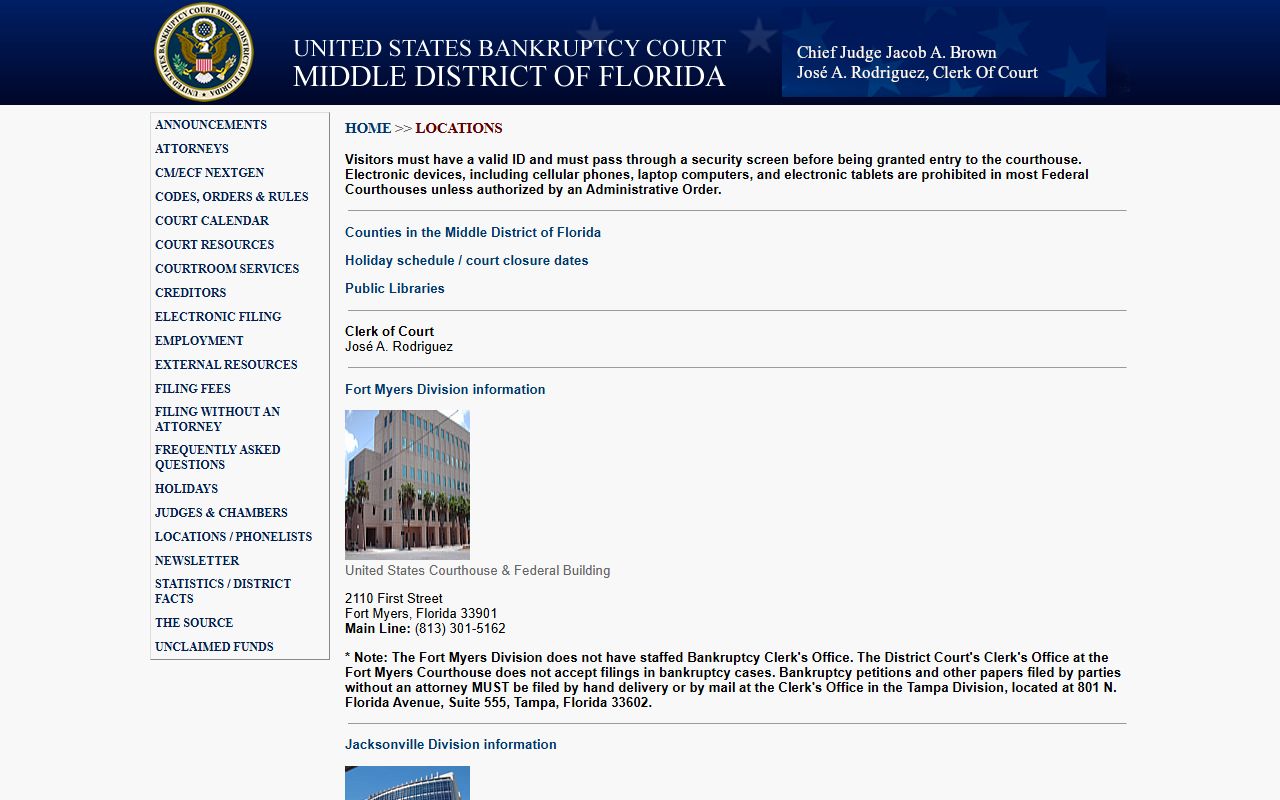
This page shows the Jacksonville Division courthouse that handles all St. Johns County bankruptcy filings, along with other division locations in the Middle District.
| Clerk | Brandon J. Patty |
|---|---|
| Address | 4010 Lewis Speedway, St. Augustine, FL 32084 |
| Phone | (904) 819-3600 |
| Website | stjohnscclerk.com |
Bankruptcy Court for St. Johns County
St. Johns County bankruptcy filings go to the U.S. Bankruptcy Court for the Middle District of Florida, Jacksonville Division. The courthouse is at 300 North Hogan Street, Suite 3-150, Jacksonville, FL 32202. Call (904) 301-6490 for court information. The Middle District of Florida bankruptcy court website has all the local rules, filing instructions, forms, and hearing schedules that apply to St. Johns County cases.
The federal court system operates separately from Florida state courts. The St. Johns County Clerk does not accept or process bankruptcy petitions. All filings go directly to the federal court in Jacksonville. A trustee gets appointed to each case to review the debtor's assets and liabilities. St. Johns County residents travel to Jacksonville for hearings. Under 11 U.S.C. Section 109, filers must reside in the district or own property there. St. Johns County is in the Middle District, so residents use the Jacksonville Division.
St. Augustine is about 40 miles south of Jacksonville. The drive takes around 45 minutes to an hour, depending on where in St. Johns County you are coming from. The northern parts of the county near Ponte Vedra are closer to the courthouse.
Search St. Johns County Bankruptcy Cases
You can look up St. Johns County bankruptcy records three ways. PACER is the main online tool. VCIS is a free phone option. And the Jacksonville courthouse has public terminals for walk-in use.
PACER is the electronic records system used by all federal courts. It includes the Middle District of Florida where St. Johns County cases are filed. Register for a free account, then search by debtor name, case number, or Social Security number. Documents cost $0.10 per page, capped at $3.00 per document. If your quarterly total stays under $30, the fee is waived. Given St. Johns County's large and growing population, there is a good volume of cases to search through. Under 11 U.S.C. Section 107, these are public records. Anyone can access them.
VCIS is the Voice Case Information System. It is free and available around the clock. Call 1-866-222-8029 to check on St. Johns County bankruptcy cases at any time. The automated system tells you if a case exists, the case number, filing date, chapter type, and current case status. No account is needed. VCIS is handy when you need a quick answer about a specific person or case without going online.
For in-person searching, visit the courthouse at 300 North Hogan Street in Jacksonville. Free public access terminals let you browse and view St. Johns County bankruptcy files. Bring a photo ID. Clerk staff can help you find and copy specific documents from case files.
Filing Bankruptcy in St. Johns County
St. Johns County residents who need to file bankruptcy most often choose Chapter 7 or Chapter 13. Chapter 7 eliminates most unsecured debts, though some assets may be at risk. Chapter 13 sets up a repayment plan lasting three to five years that lets you keep your property. The Chapter 7 filing fee is $338. Chapter 13 is $313. The court allows installment payments if you cannot pay the full amount at filing.
Credit counseling from an approved agency must be completed before you file. The U.S. Department of Justice lists approved counseling providers for the Middle District of Florida. This is a federal legal requirement. You also need to pull together your financial information: tax returns from the past two years, pay stubs, bank statements, and detailed lists of debts and assets. All forms and schedules go to the Jacksonville Division court.
When you file, the automatic stay under 11 U.S.C. Section 362 takes effect immediately. Creditors must stop collecting. Calls stop. Lawsuits pause. Garnishments end. Foreclosure halts. The court schedules a meeting of creditors about 30 to 45 days after filing. Download official forms from the U.S. Courts website.
St. Johns County Legal Help
Getting legal help with bankruptcy in St. Johns County is possible through several sources. Florida Legal Services provides free legal assistance to qualifying low-income individuals across the state, including St. Johns County residents. They help with evaluating options and completing paperwork.
The Florida Bar runs a lawyer referral service for St. Johns County. A small fee gets you a consultation with a local bankruptcy attorney. Jacksonville Area Legal Aid also serves St. Johns County residents and can help with debt-related civil legal problems. For those who want to file pro se, the Middle District court website has guides and sample forms. Pro se means you handle the case yourself without an attorney. Under 11 U.S.C. Section 727, a Chapter 7 discharge releases the debtor from personal liability on most debts. Using the court's resources or hiring a lawyer can help you navigate the process smoothly.
The St. Johns County Bar Association is another local resource that can connect residents with attorneys experienced in bankruptcy filings in the Middle District.
Remember, certain debts survive bankruptcy. Child support, alimony, student loans, and some tax debts are not dischargeable under 11 U.S.C. Section 523.
Cities in St. Johns County
St. Johns County is home to St. Augustine, St. Augustine Beach, Ponte Vedra Beach, Nocatee, and several other communities. The county has experienced rapid population growth, particularly in the northern part near Jacksonville. All bankruptcy filings from St. Johns County go through the Jacksonville Division of the Middle District court, regardless of which community you live in.
No cities in St. Johns County currently meet the population threshold for a dedicated page. All communities in the county file bankruptcy through the same federal courthouse in Jacksonville.
Nearby Counties
These counties border St. Johns County. Be sure to verify which county you reside in before filing. Your county determines which federal court division handles your bankruptcy case.